What Are the Most Durable Skid Steer Attachments for Heavy-Duty Land Clearing?

When a grapple tine snaps mid-job or a brush cutter cracks under load, downtime means lost revenue, missed deadlines and the frustration of equipment that couldn’t keep up. Standard attachments look capable on paper, but when you’re pulling stumps, mulching brush or moving rocks daily, the difference between durable and good enough shows up fast.
This guide breaks down the most durable skid steer attachments for heavy-duty land-clearing and the nonnegotiable features that separate professional-grade tools from the ones that’ll leave you stranded. You’ll know exactly what to look for to protect your uptime and maximize your investment.
Why Standard Attachments Fail Land Clearing
Land clearing involves dealing with abrasive soil, impact loads from rocks and roots and sustained stress that pushes equipment to its limits. When a standard attachment fails, the costs add up — emergency repairs may run higher than planned maintenance, and a single bad hydraulic coupler can damage your entire skid-steer system.
Cheaper attachments often use thinner steel, skip critical reinforcement and rely on stitch welds that crack under load. You could save a few hundred dollars up front, but when you factor in the total cost of ownership (TOC) of budget versus high-quality attachments, the math doesn’t work in your favor.
Making the right choice from the start means understanding what separates a professional-grade attachment from one that’ll cost you more in the long run. Choosing the right attachments starts with knowing which tool you can rely on when the work gets tough.
Durable Land Clearing Attachments by Application
Land clearing involves various specialized tasks, and each demands attachments built to handle the toughest jobs. Check out the most durable options below.
Clearing Overgrowth and Dense Brush
When you’re tackling heavy vegetation, forestry mulchers and brush cutters are your first line of attack. Their durability depends on critical components that determine whether your attachment lasts years or a season:
- Replaceable carbide teeth: These cutting edges take the brunt of contact with wood and debris. When they wear down, swap them out instead of replacing the entire unit, keeping you operational without major expense.
- Reinforced housings: The housing protects internal components from impact and contains the heat generated during continuous mulching operations.
- Cutting capacity: Vertical shaft mulchers, depending on brand, machine and model, can handle material up to 6 to 8 inches, while horizontal shaft units can tackle trees up to 30 inches in diameter. A bad boy like the Decimator Disc Mulcher features a 14-inch cutting capacity, so you can clear dense brush without constantly stopping to section larger material.
Uprooting Roots and Debris
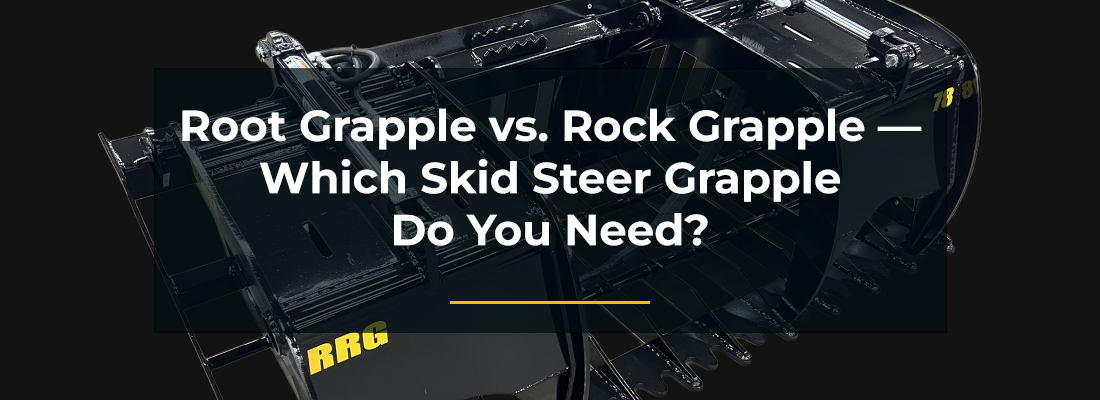
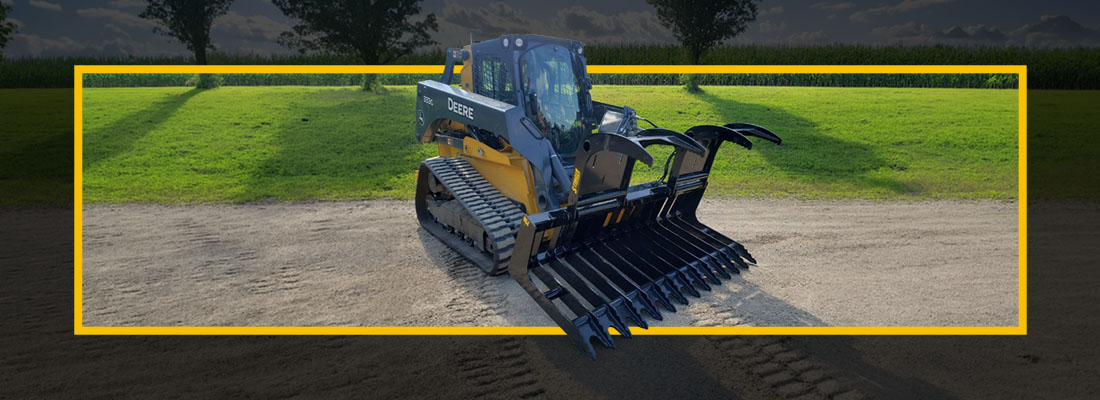
Root grapples take over once the brush is down. You need strong tines and powerful hydraulics to pull stumps and clear debris without bending or snapping under load. A root and rock grapple is purpose-built for this phase, with tines designed to dig deep and hydraulic cylinders that deliver consistent clamping force.
This is where inferior welds and thin steel show their weaknesses. A root grapple that’s truly built for land clearing is unlikely to fold when you hit resistance — it’ll power through and let you maintain momentum across the job.
Felling and Sectioning Trees
Tree shears and pullers demand hardened steel blades and protected hydraulic systems. When you’re felling trees or sectioning trunks, blade edge retention and cylinder protection make the difference between clean cuts and equipment damage. A skid steer tree puller is designed to handle this phase with reinforced construction that protects critical components from impact and debris.
Whether you’re clearing wooded lots or managing selective timber removal, the tool needs to withstand side loads, twisting forces and the shock of felling operations without compromising hydraulic integrity.
Moving Rocks and Materials
Once the vegetation and trees are down, you’re left with rocks, logs and debris that need to be moved off-site. This is where heavy-duty grapple buckets, rock buckets and log grapples earn their keep. High-strength steel grades become critical in this phase. It resists abrasion from rocks and withstands the impact of loading and unloading heavy materials.
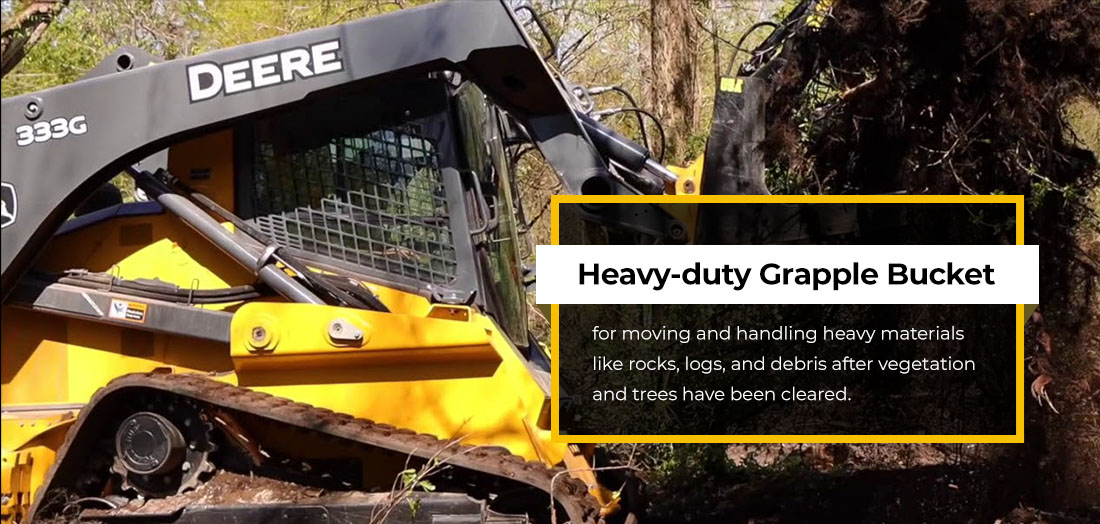
A heavy-duty grapple bucket is a prime example of a tool built for this work, with steel thickness and gusset placement designed to handle sustained abuse. Whether you’re sorting boulders or stacking logs, you need an attachment that won’t deform or crack after a season of hard use.
Key Features of Durable Attachments
Here’s your buyer’s checklist — the nonnegotiable features that separate professional-grade attachments from the ones that’ll leave you stranded.
Steel Grade and Thickness
High-strength steel grades used in durable attachments can have a Brinell Hardness Number (BHN) of 400 or higher, while basic mild steel typically has a BHN of approximately 130. That difference directly translates into abrasion resistance and impact strength. When manufacturers use vague terms like “heavy-duty” without specifying steel grade, you’re guessing at what you’re getting.
High-strength steel resists wear from rocks, roots or abrasive soil, and the constant contact wears through thinner materials much faster. This is the real deal for commercial land clearing, built to take the hits and keep working. Understanding steel hardness and toughness helps you evaluate whether an attachment is truly built for the job or just marketed that way. Look for specs that state the steel grade and thickness in critical wear areas.
Continuous Weld Quality
A continuous weld runs the full length of a seam without gaps, distributing stress evenly across the joint. The kind you see on budget attachments — stitch or tack welds — leave weak points where cracks start under load. Visually, a continuous weld looks like an unbroken bead along the seam, while a stitch weld appears as a series of short segments with gaps in between.
When you’re applying thousands of pounds of force through an attachment, those gaps become failure points. Continuous welds cost more to produce, but they’re the difference between an attachment that holds up over time and one that cracks after a few hard jobs.
Strategic Reinforcement and Gussets
Smart design places reinforcement strategically to handle the forces the attachment will encounter. Gussets at high-stress points, like where tines meet the frame or where cylinders attach, prevent metal fatigue and structural failure. This is about placing strength exactly where it’s needed, not adding unnecessary weight.
Understanding how to attach skid steer attachments also plays a role in longevity.
High-Quality Components
Hydraulic cylinders, hoses, cutting teeth and pivot points all need to match the frame’s durability. Cheap cylinders leak, low-quality hoses burst and substandard teeth wear down fast. Any one of these failures takes you off the job. An attachment is only as strong as its weakest part. This philosophy extends to every component choice, from the grade of hardware to the quality of bearings.
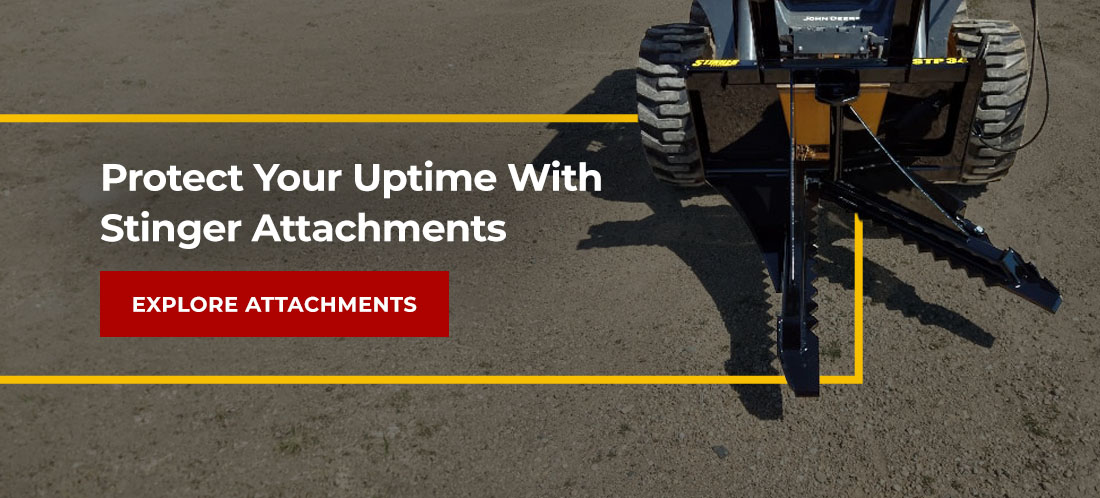
Protect Your Uptime With Stinger Attachments
You’re running a land clearing operation, and every hour your equipment sits idle costs you money. If you’re looking for the most durable skid steer attachments for heavy-duty land-clearing, Stinger Attachments delivers.
We build American-made attachments built to last, keeping you working when cheaper alternatives fail. Each attachment is crafted by a team of professionals who take pride in building some of the best equipment on the market, and we back it with exceptional customer service and direct-to-consumer pricing.
Browse our full selection of durable land-clearing attachments or contact us today to discuss the tools that are right for your operation.