Are More Expensive Skid Steer Attachments Always More Durable?

The real measure of skid steer attachment value isn’t price — it’s total cost of ownership. A durable attachment might cost more up front, but it pays you back through years of reliable work, minimal downtime and the peace of mind that comes with a tool you can count on.
This guide provides a framework for spotting true quality and choosing a durable attachment that delivers real value. You’ll learn what makes an attachment last, how to evaluate quality before you buy and why the best investment is one that’s dependable enough to meet your toughest work demands.
The Connection Between Price and Attachment Durability
The truth is that a high price tag doesn’t automatically mean high quality. Some higher-priced attachments may still rely on thinner steel, inconsistent welds or imported components that don’t justify the premium. It’s a story contractors know all too well, where you can spend what feels like a premium price on an attachment, only to face cracked welds, bent tines or downtime sooner than expected.
So what should you pay for? The answer is engineering, materials and craftsmanship. Attachments from manufacturers who are transparent about their sourcing, regardless of origin, make it easier to verify the welding standards and material specifications. For some buyers, locally sourced products can also be more convenient, since you can get support for them more easily.
Your money can go toward attachments priced to reflect quality materials and thoughtful design. You can also feel better choosing a manufacturer who stands behind their work. That’s the difference between an investment that pays you back and an expensive mistake with a premium price tag.
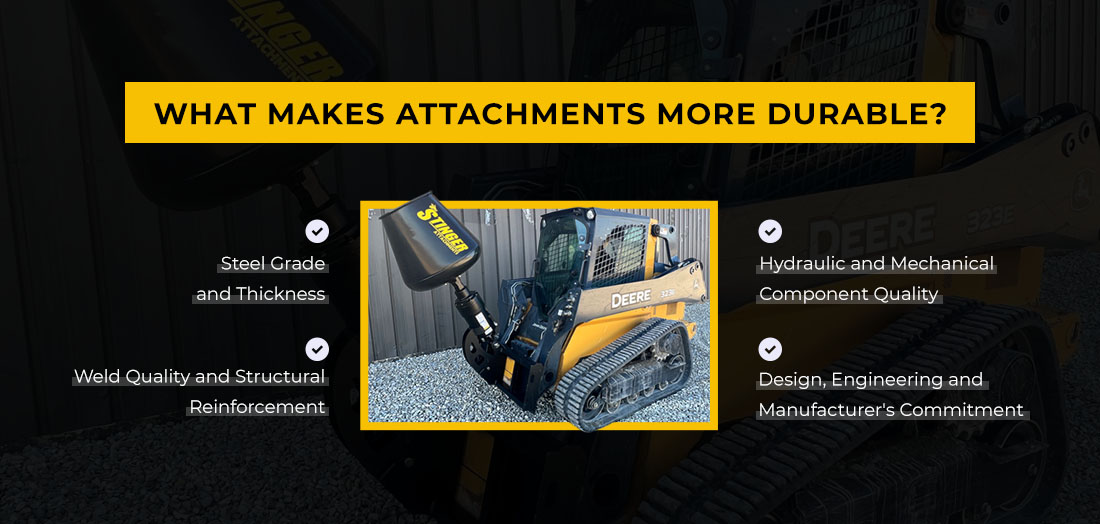
What Makes Attachments More Durable?
Explore the key considerations for determining an attachment’s overall durability.
Steel Grade and Thickness
The steel grade can tell you a lot about the attachment’s durability. After all, the steel is what stands between you and a bent bucket or cracked frame when you’re clearing brush, moving rock or handling heavy loads.
Many durable attachments feature steel grades with a Brinell Hardness Number (BHN) of 400 or higher. This can provide better resistance to wear and deformation compared to more common structural steel, which is often around BHN 130. The higher grade steel may resist bending, cracking and fatigue under the intense forces of professional work.
Durability also depends on the specific steel alloy, its thickness and application-specific engineering. Thicker steel adds weight and cost, but it’s critical for attachments that need to handle serious jobs day in and day out.
Reputable manufacturers are proud to state the grade and thickness of their steel. Clear material specs are a sign of confidence and transparency, so look for manufacturers who share these details openly.
Weld Quality and Structural Reinforcement
Quality welds are just as important as the steel itself. Welds bear concentrated stress loads, so they’re a key indicator of an attachment built to last. A durable weld is clean and consistent. You’ll see what pros call “stacked dimes,” a uniform bead that runs smooth and even. Sloppy, irregular welds with gaps or inconsistent penetration are a sign of rushed work or inexperienced fabrication. You don’t want to bet your productivity on that.
It’s also important to look at the gussets. These are triangular or angled reinforcement plates that distribute stress in high-load areas, such as corners and mounting points. Some lower-cost tools may compromise structural reinforcements, like gussets, to reduce material and labor costs. This can increase their risk of failing under pressure.
Hydraulic and Mechanical Component Quality
Hydraulics, bearings and pins are essential for operating your attachment. A strong frame matters, but dependable components in these critical systems are what keep you productive day after day.
Reputable manufacturers, regardless of their price point, use reliable, high-quality components from established suppliers, so you have confidence in long-term performance. Quality hydraulic motors and cylinders deliver years of dependable service, protecting your investment through consistent uptime and minimal maintenance needs.
Look for quality indicators like greasable pins. They’re a small detail, but they allow for regular maintenance and dramatically extend the life of pivot points and moving parts.
Design, Engineering and Manufacturer’s Commitment
Great durability comes from smart design that places high-quality materials and reinforcements where they matter most. It’s not just about throwing more steel at the problem. It’s about engineering that understands load distribution, stress points and real-world operating conditions.
A manufacturer’s commitment to quality control and rigorous design principles, rather than simply their manufacturing origin, truly determines durability. Whether you’re running a Bobcat, Cat, John Deere or Kubota machine, choosing attachments from manufacturers who prioritize design and quality gives you the confidence that your equipment will perform well in demanding jobs.
How to Assess Skid Steer Attachment Quality
Now that you know what makes an attachment durable, here’s a simple checklist you can use to assess any attachment.
1. Check the Material Specs for Steel Grade and Thickness
Be a detective. Look for the steel grade and thickness on the product spec sheet. If a manufacturer doesn’t list these details, ask yourself what’s being hidden. Reputable builders know their materials and aren’t shy about sharing them. The material specs can give you a good idea of whether you’re choosing a lasting, high-quality attachment.
2. Visually Inspect the Welds and Gussets
Look closely at product photos or the attachment itself. Are the welds neat and uniform? Do you see extra triangular plates supporting the corners and joints? These are visible signs of a well-built tool. If the welds look inconsistent or you don’t see reinforcement in obvious stress areas, keep shopping.
3. Identify the Component Brands
Look for information on the hydraulic motor, cylinders and bearings. If component brands aren’t explicitly listed, you might want to ask about the quality of these parts. Transparency about component sourcing is generally a positive sign of manufacturer confidence.
4. Compare Overall Weight and Design
For similarly sized attachments, greater weight often indicates thicker steel plates or additional reinforcements, such as wear bars and gussets, which can enhance durability. However, material quality and design are equally important. You’ll want to make sure the attachment uses premium-grade steel and advanced alloys to stand out in terms of durability. You can also check for smart design features, such as protected hose routing that prevents job-site damage.
5. Review the Parts Support
Reliable parts and responsive service are critical for maximizing your attachment’s uptime and overall value. A quality provider ensures easy access to replacement parts and streamlines the ordering process.
Beyond just parts, look for a partner with experts and responsive customer service. Prompt answers and efficient support help minimize downtime, keeping your operations productive.
Find Durable, High-Quality Attachments at Stinger Attachments
As a contractor or owner-operator, you’re making strategic decisions for your business — not just buying equipment. When you choose Stinger Attachments, you’re getting the quality indicators you just learned about at a fair, direct-to-consumer price.
We’re a small team of professionals who take pride in building American-made attachments for reliable performance. And when you have a question about compatibility, specs or shipping, we answer the phone. Quality doesn’t have to break the budget. Ask about flexible payment options that make durable equipment more accessible.
Ready to find a durable attachment built to last? Call us at 507-416-7956 or send us a message today to find the right skid steer attachments for your operations.