
How Do Auger Drives Work for Digging Post Holes?
Fence-building season is closing in fast, and post holes are the first thing standing between you and the finished line. Most farmers know an auger for post holes gets the job done, but fewer know how it actually works. That gap matters when you’re picking equipment that has to perform in real dirt.
An auger drive takes hydraulic power from your skid steer or tractor, runs it through a gearbox that multiplies it into serious rotational torque, then sends it to an auger bit that bores cleanly into the ground. Understanding how these parts work together shows you exactly what makes a drive muscle through hard-packed clay with steady, reliable power, hole after hole.
The Three Components That Do the Work
An auger drive turns hydraulic power into a finished hole through three components working in sequence, whether you’re setting fence posts or adding new tractor attachments to your farm operation’s lineup.
1. Hydraulic Motor
The hydraulic motor kicks off the chain, taking pressurized fluid from your skid steer or tractor’s auxiliary hydraulic circuit and converting that flow into rotation — oil in, rotation out. Hydraulic pressure, combined with flow, determines the rotational force that reaches the gearbox.
Choosing a hydraulic auger for skid steer work means choosing a motor that can take that pressure day after day, which is why Stinger’s Auger Drive runs on an Eaton motor engineered to nail the job.
2. Planetary Gearbox
The planetary gearbox comes next, acting as the torque amplifier for the whole operation. The motor spins fast, but it relies on the gearbox to convert that speed into serious twisting power. This breakdown of how a planetary gearbox works covers the sun gear, planet gears and ring gear that make it happen. It works much like dropping a truck into low gear, trading top speed for the muscle to push through resistance.
That torque multiplication is what lets a drive punch through clay and hard-packed ground with steady, reliable power. It’s why gearbox quality matters as much as horsepower when you’re shopping for a skid-steer auger drive.
3. Auger Bit
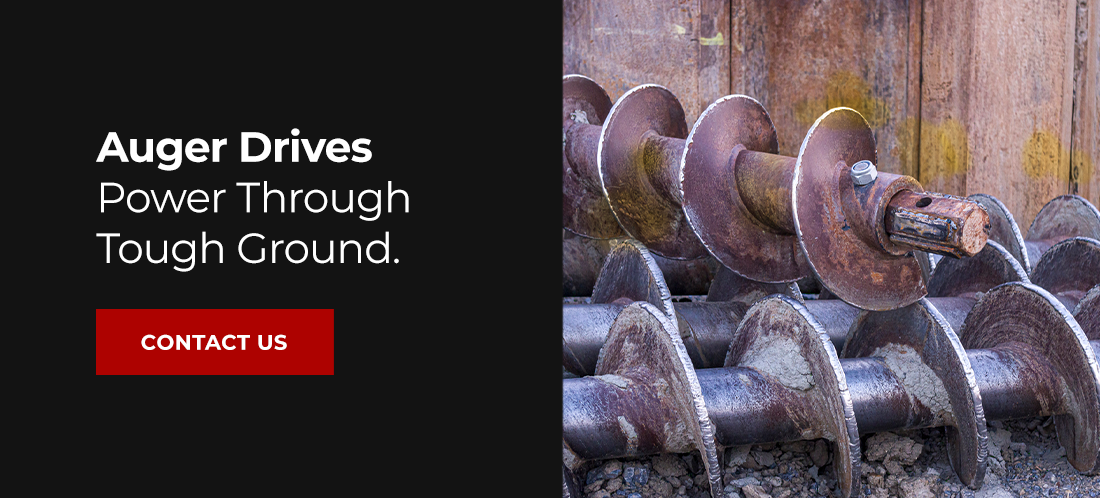
The auger bit is the business end of the operation, connecting to the gearbox’s output shaft and spinning straight into the ground, where its helical flighting handles two jobs at once. The cutting edge at the bottom breaks up soil, while the spiral above lifts that material out of the hole as the bit descends. This leaves you with a clean, open hole ready for the post.
Fence post jobs typically call for 9- to 12-inch-diameter bits, a common thread across many skid-steer auger applications.
You can browse a full auger lineup to match a bit to your job, though the drive matters just as much as the bit. A sharp auger bit for skid-steer work performs best when it’s paired with a drive that delivers enough torque to match tough ground conditions.
How an Auger Drive Compares to a Handheld Post-Hole Digger
A handheld post-hole digger relies entirely on your own muscle. An auger for post holes taps hydraulic power instead, multiplying your machine’s output through the planetary gearbox to generate torque well beyond what manual effort can provide. That advantage shows up in speed, soil handling and consistency.
A powered drive gets through a hole in a fraction of the time hand digging takes, especially when you’re setting more than a handful of posts. That pace holds steady even as soil conditions get tougher. Clay, rocky ground and hard-packed earth that challenge a hand tool barely slow down a hydraulic drive at all.
That same power translates into consistency. Post depth generally runs about one-third the post length, so a 6-foot post needs roughly a 2-foot hole by standard fence post installation guidelines.
A hydraulic auger drive holds that same depth and diameter hole after hole, which is exactly the kind of reliability you need when you’re building fences for the farm.
When you’re setting posts, a skid steer post-hole digger is the standard for a reason. You can check out the top skid steer attachments built specifically for this kind of work.
Matching an Auger Drive to Your Skid Steer or Tractor
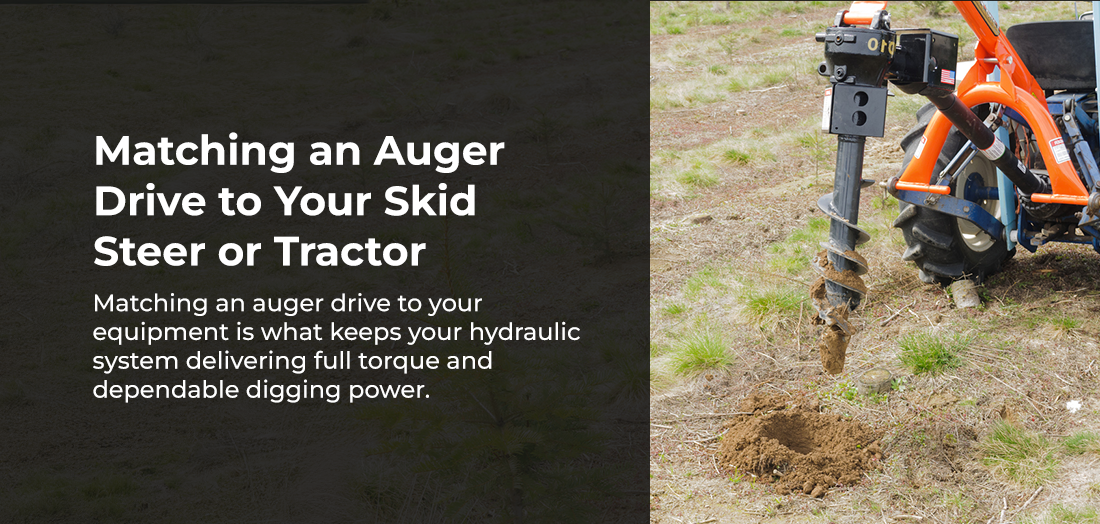
Matching an auger drive to your equipment is what keeps your hydraulic system delivering full torque and dependable digging power. The drive’s hydraulic needs have to line up with what your machine actually puts out.
That’s true whether you’re running a skid steer auger attachment on a full-size loader or setting up a 3-point auger for a smaller tractor, like the attachments for compact tractors built for Kubota and similar machines. Every auger drive has a rated flow range, measured in gallons per minute (GPM), and staying within it keeps your torque strong and your motor running the way it should.
Before ordering, confirm your machine’s mount style and hydraulic flow rating so the drive, bit and carrier are ready to work together from the first hole.
Standard Flow vs. High Flow
Whether you’re running a post-hole auger for tractor jobs or a full-size skid steer, your machine’s auxiliary hydraulic circuit falls into one of two camps. Standard-flow systems produce a lower hydraulic flow rate, while high-flow setups move more hydraulic fluid at similar pressure.
Stinger’s Auger Drive comes in standard and high-flow configurations, so you can match your drive’s flow rating to your machine’s actual output.
If you’re running a smaller rig, the Mini Auger Drive is built for compact tractors and mini skid steers running lower flow rates.
How Your Machine’s Hydraulic Flow Affects Performance
Flow rate helps determine how fast the bit spins, while hydraulic pressure and the gearbox work together to deliver the torque needed for tough digging. Matching your drive to your machine’s rated flow keeps both running at full strength, even in tough soil.
Stinger’s Auger Drive pairs its Eaton motor with a built-in pressure relief valve that manages pressure spikes during hard drilling, keeping performance steady without a separate, bulky valve block. That design also means fewer leak points and less maintenance down the road.
See Stinger Attachments Auger Drives
Now that you know what’s happening inside an auger drive, you know what to look for when you’re shopping for a skid steer auger attachment. At Stinger Attachments, as the manufacturer, we build these drives ourselves, engineering the motor, gearbox and bit compatibility from the ground up, right down to details like an Eaton motor with a built-in pressure relief valve.
Check out Stinger’s Auger Drive in standard and high-flow configurations, or grab the Mini Auger Drive if you’re running a smaller machine. Either way, this bad-boy is built to keep digging when the ground gets tough.