Is It Worth Buying Separate Attachments for Farming and Landscaping?

When running a farming operation, you may need to clear brush or grade a path from time to time, and if you handle landscaping jobs, you might need to move hay bales or pull stumps to complete a project. So, do you need to buy separate attachments for farming and landscaping, or can versatile tools handle both types of work?
This guide shows you when specialized attachments pay off and when a high-quality, versatile tool is the better choice.
Understanding Specialized versus Versatile Attachments
The best skid steer attachments are purpose-built implements that connect to your machine via a universal quick-attach system. Specialized attachments do one job exceptionally well, while versatile skid steer attachments handle multiple jobs across different work types.
| Feature | Specialized Attachments | Versatile Attachments |
|---|---|---|
| Examples | Manure forks, bale spears, tree pullers, land levelers | Grapple buckets, 2-in-1 buckets, brush cutters, pallet forks |
| Best for | High-volume work, precision jobs, niche operations | Mixed operations, varied daily work, unpredictable demands |
| Up-front cost | Higher per attachment | Moderate investment |
| Performance | Peak efficiency at one job | Strong performance across multiple jobs |
| Jobsite efficiency | Fast at its purpose, slow if swapping is needed | High efficiency for varied work without swapping |
What Are Specialized Skid Steer Attachments?
Specialized attachments are engineered to excel at one job. For example, certain agricultural skid steer attachments deliver peak performance because every design element serves a single purpose.
Key advantages include:
- Efficiency for repetitive work: A dedicated tool saves time on every cycle when you’re moving manure daily or handling dozens of bales.
- Purpose-built durability: They are reinforced exactly where that job creates stress, which reduces repair needs.
- Professional-grade results: Precision matters when the job demands premium results.
There is a trade-off when buying specialized farming and landscaping equipment. You’re investing in equipment that only handles one type of work. If you’re not using it regularly, that tool sits idle while you’ve got money tied up in it.
What Are Versatile Skid Steer Attachments?
These attachments work across different job types, increasing your machine’s utilization. A grapple bucket moves brush on a landscaping site and handles debris on a farm. Versatile skid steer landscaping attachments eliminate the need for constant attachment swaps.
Benefits include job flexibility, lower total investment and reduced transport hassle. A well-built, versatile attachment performs strongly across all its intended uses.
When Buying Separate Specialized Attachments Makes Sense
If your operation fits certain criteria, investing in purpose-built tools delivers better returns than trying to make one attachment for farming and landscaping do everything.
Efficiency With High Volume Work
When you’re doing the same job daily or weekly, the time savings from a specialized tool compound rapidly. A farmer moving manure every day gains minutes per cycle with a specialized manure grapple versus a general-purpose bucket. Those minutes add up to hours per week and significant labor cost savings over a season.
If the time saved pays for the attachment within a year or two, the specialized tool is the right investment.
Performance in Precision Jobs
Some jobs demand precision. Fine grading for hardscaping or precise land leveling requires specialized landscaping equipment designed for the task. When your reputation depends on professional results and your customer is paying for precision work, the specialized attachment justifies its cost.
Unique Materials and Machine Classes
Specialized vs. multipurpose attachments also make sense in these scenarios:
- Large volumes of silage or oversized rocks require purpose-built strength.
- A large wheel loader versus a compact skid steer often needs matched equipment for different machine classes.
- When working on multiple jobsites simultaneously, dedicated attachments let each operator work efficiently without waiting for shared tools.
When One Versatile Attachment Is the Smarter Investment
For many operators, a well-built, versatile skid steer attachment delivers better return on investment (ROI) than multiple specialized tools.
Optimizing Value in Mixed Use Operations
If you spend roughly 80% of your time on varied work and only 20% on any single specialized job, a high-quality, versatile tool that handles the 80% effectively is the better investment. A versatile heavy-duty grapple bucket moves materials, clears brush, handles debris and grabs awkward loads across both farming and landscaping applications.
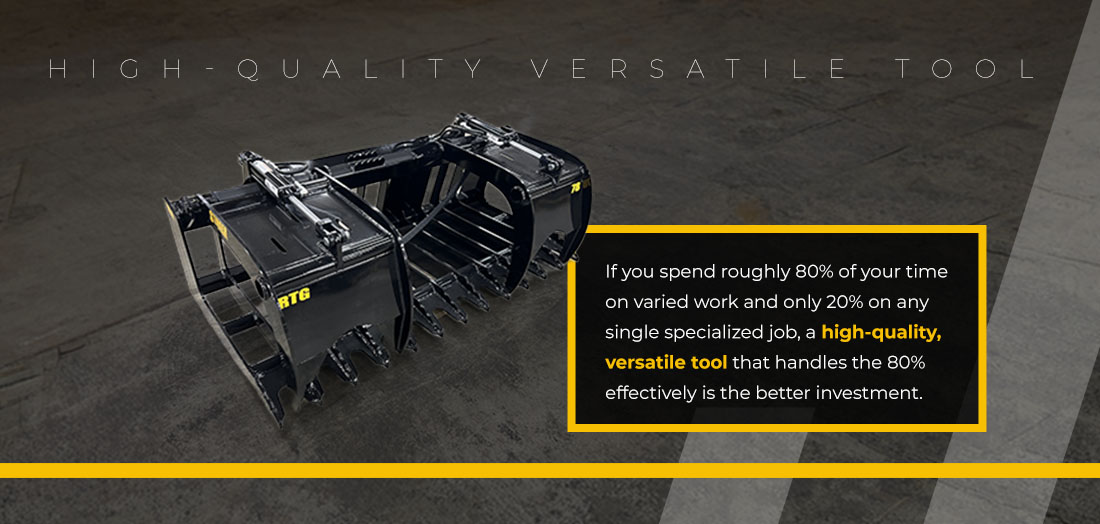
The same applies to brush cutters and disc mulchers for pasture maintenance, property clearing and land preparation. You’ll find many uses for tree pullers beyond removing trees, from post pulling to stump extraction.
Maximizing ROI on a Single Machine
A skid steer equipped with versatile attachments can replace the work of multiple specialized machines. That single piece of equipment becomes more profitable because it’s generating revenue across a wider range of billable jobs.
Heavy-duty options like powerful brush cutters and skid steer disc mulchers tackle vegetation management across farms, rural properties and commercial landscaping sites. The attachment pays for itself faster because it’s working more hours across different job types.
Reducing Jobsite Downtime and Transport Costs
Multiple specialized attachments create hidden costs:
- Every attachment swap burns billable minutes, especially when jobs require frequent equipment switches.
- Transporting additional attachments adds weight, requires trailer space and increases fuel costs.
- More equipment means additional time spent organizing, loading and unloading at each site.
A versatile skid steer attachment eliminates most swaps and simplifies logistics. You show up ready to handle whatever the job demands without stopping to change equipment.
A Simple Framework for Your Attachment Decision
This three-step framework helps you analyze your operation and make the choice that maximizes profitability.
1. Audit Your Jobs and Billable Hours
List your most common jobs over the past 6 to 12 months. Categorize each as farming, landscaping or mixed work, and estimate the hours spent on each. Pay attention to these patterns, and consider the following:
- Weekly or daily work is a strong candidate for specialized attachments.
- Irregular work might be better served by versatile tools.
- Multiple varied jobs on the same day favor versatile skid steer attachments that eliminate the need to swap.
2. Calculate Total Cost of Ownership
The framework for evaluating equipment costs considers the complete picture:
- Initial investment
- Maintenance expenses
- Repair costs
- Operational downtime
- Resale value
The basic formula is:
- Total cost of ownership (TCO) = purchase price + maintenance costs + repair costs + downtime losses − resale value.
Consider a five-year comparison between a budget bucket and a high-quality option. Let’s say a budget bucket costs $1,500 up front but lasts two years. Over five years, you’ll buy three buckets for a total of $4,500. A high-quality bucket costs $3,500 but lasts the full five years.
An example of the operating costs tells the rest of the story:
- Budget bucket: $1,000 in maintenance + $800 in repair costs + $1,500 in downtime productivity losses = $7,800 total five-year cost
- High-quality bucket: $500 in maintenance + $150 in repairs + $150 in downtime = $4,300 total five-year cost
The budget option costs nearly twice as much over five years. Understanding the expected lifespan of skid steer attachments helps you accurately project your business’s cost scenarios. Your actual numbers will vary based on usage intensity and labor rates, but the pattern holds — quality equipment delivers lower total ownership costs.
3. Factor in Hidden Performance Costs
Some costs never show up on your spreadsheet but impact profitability:
- Lost billable hours: Underperforming tools that take longer to complete a job limit how many jobs you can handle daily.
- Work do-overs: Subpar equipment forces you to redo work, meaning you’re incurring costs twice.
- Reputation damage: Word spreads fast about operators who can’t deliver quality results on time.
Operators known for quality work and reliable timelines command premium rates and steady referrals.
Find Your Optimal Attachment Setup With Stinger Attachments
Deciding whether to buy separate attachments for farming and landscaping depends on your workload. The smartest investment is always equipment that delivers long-term value for your specific operations.
Stinger Attachments builds heavy-duty, American-made solutions. Every attachment is built with higher-grade steel and years of manufacturing experience. You get specialized tools for high-volume work or versatile attachments that can handle multiple jobs without compromise.
Browse the different types of skid steer attachments available, or reach out with questions about finding the right cost-effective skid steer setup for your operation.