How to Choose the Right Size Grapple for Your Skid Steer

Getting the right grapple for your skid steer protects your equipment investment and delivers maximum performance on every job. When your grapple matches your machine’s lifting capacity and the debris you handle most, you’ll move more material in fewer trips while keeping your equipment running safely for years to come.
Whether you’re clearing brush on your property, moving rocks at a construction site or tackling demolition work, the right-sized grapple turns your skid steer into the versatile workhorse you need. This guide explores how to choose the right grapple size to protect your machine and deliver the results you’re after.
1. Know Your Skid Steer’s Lifting Power
Before you look at any grapple, you need to understand your machine’s limits. Do the following:
- Find your rated operating capacity (ROC): The most important number is your skid steer’s rated operating capacity (ROC). This is the safe, usable lifting weight your skid steer can handle day in and day out without wearing down hydraulic components or stressing the frame. You’ll find your machine’s ROC in the operator’s manual, on the manufacturer’s website or on the data plate attached to your skid steer.
- Use the 50% rule: Your skid steer’s tipping load is the maximum weight that will cause the machine to tip forward. Manufacturers calculate ROC as 50% of this tipping load for safety. When evaluating your skid steer’s lifting capacity, always start with ROC — never the tipping load. Operating within ROC limits extends your machine’s life and protects critical components.
- Calculate your total load: The costliest mistake operators make is forgetting that the grapple’s weight counts against your ROC. If your skid steer has a 2,000-pound ROC and you mount a 700-pound grapple, you only have 1,300 pounds of lifting capacity left for debris.
Subtract the grapple’s weight from the machine’s ROC to figure out the weight of material you can lift. This calculation protects your equipment investment and helps you choose a grapple that handles full loads without strain.
2. Assess Your Skid Steer’s Hydraulic Flow
Once you know your lifting capacity, check hydraulic compatibility. The good news? This is simpler than most operators think, and getting it right saves you money.
Most grapples use hydraulic cylinders for clamping, which run perfectly on standard flow systems. High-flow systems are reserved for attachments with hydraulic motors, like mulchers and stump grinders. If you’re only running a grapple, skip the high-flow upgrades and save thousands of dollars.
Check your operator’s manual, the manufacturer’s website or the machine’s data plate for gallons per minute (GPM) and pounds per square inch (PSI) ratings.
3. Align the Grapple Type With Your Debris
Match your grapple to the debris you handle most. Different grapples are built for different jobs, and choosing the right style maximizes your return on investment:
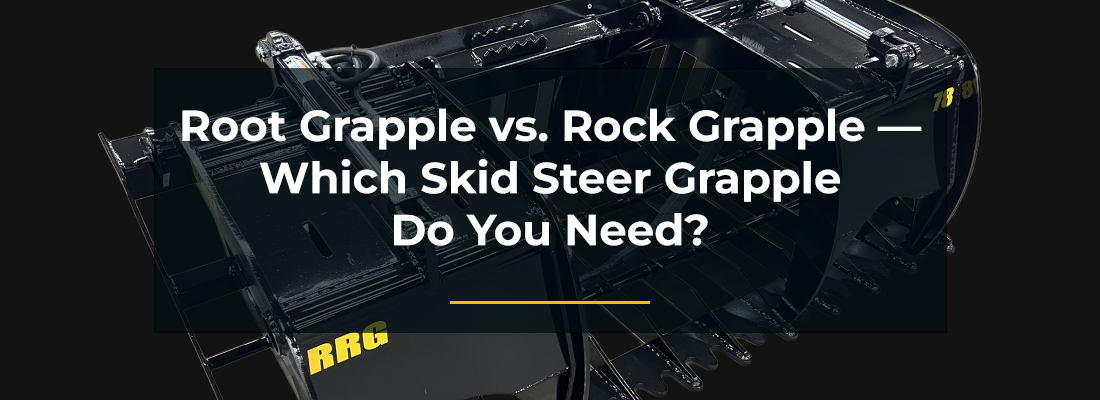
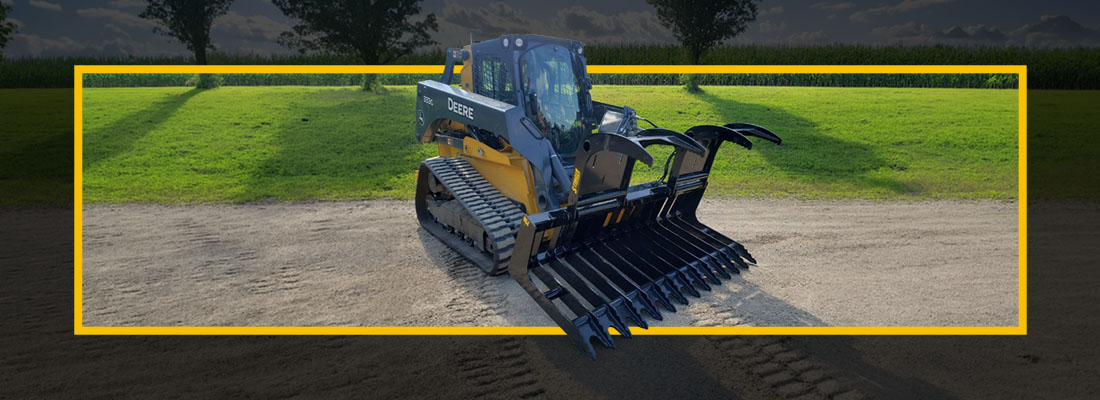
- Root grapples for all-purpose land clearing: Root grapples are the workhorses of land clearing. Open tines sift dirt while grabbing roots, logs, brush and mixed debris. The tine spacing lets soil fall through while keeping branches, stumps and rocks locked in place. If your work involves clearing property, tearing down structures or moving mixed debris, a root grapple delivers versatility that pays off across multiple job types. These bad boys can handle everything from brush piles to demolition work.
- Rock grapples for heavy rocks, concrete and demolition: Rock grapples are built for heavy materials. Tighter tine spacing and reinforced construction grab and hold rocks, concrete chunks, and demolition debris. The heavier frame gives you clamping force for materials that would slip through a root grapple. Choose from root and rock grapple options for tough jobs.
- Brush grapples for light, bulky branches and yard waste: Brush grapples handle lighter materials, such as branches and yard waste. Many operators find that versatile root grapple handles brushwork while offering greater long-term value across jobs. Think about debris handling grapple selection in terms of what you’ll use it for 80% of the time. Choose the style that matches your most common work for the best return on investment.

4. Match the Grapple Size to Your Machine
Once you know your ROC and debris type, it’s time to select the right grapple width for your skid steer.
The right grapple width for debris handling depends on your machine’s capacity. Start with your ROC calculation, subtracting the grapple’s weight from your machine’s ROC to confirm you have enough lifting capacity left for the material you’re moving. Smaller machines with lower ROC values work best with narrower, lighter grapples that preserve lifting capacity. Larger machines with higher ROCs can handle wider, heavier grapples, maximizing productivity.
Remember, these decisions are based on grapple size matching to your specific machine’s capabilities. Always check the grapple’s weight specifications and run the calculation before you buy.
Why Getting the Right Grapple Size Is Critical
The right size skid steer grapple attachment keeps your equipment safe while getting more done in less time. Grapple attachments handle the heavy-duty work across agriculture, construction, landscaping and forestry, from land clearing and demolition to moving brush and rocks.
Get the sizing wrong, and the costs pile up fast. Too small? You’re making endless trips to move material, burning fuel and wasting hours on every job. Too large? You’re dealing with tipping hazards and hydraulic damage that’ll shorten your machine’s life. Beyond the performance hit, you’ve spent good money on equipment that’s damaging your investment instead of protecting it.
The fix is straightforward — match your grapple to your machine’s specs and the work you do most. Get it right, and you’ll finish jobs faster, protect your equipment from premature wear and get the best return on your investment (ROI).
Frequently Asked Questions About Grapple Selection
Explore answers to common questions below:
- What happens if my grapple is wider than my machine? A grapple that’s wider than your machine can limit visibility and make it harder to maneuver in tight spaces. In open areas, it increases productivity. In confined jobsites, stick to a grapple width that matches your machine’s width.
- Do I really not need high-flow hydraulics? For standard grapples, you don’t need high-flow hydraulics. Grapples use cylinders, which operate efficiently on standard flow. Skipping high-flow upgrades can save you thousands in equipment costs.
- Can I use the same grapple for different types of debris? You can use the same grapple for different types of debris, especially with root grapples. Their open-tine design handles everything from brush to rocks and mixed debris, maximizing your return on investment.
Turn to Stinger Attachments for Your Next Grapple
When you choose the right size grapple for your skid steer, you protect your equipment investment and set yourself up for safer, more efficient work. Stinger Attachments makes that choice easy. We’re a veteran-owned company that manufactures high-quality skid steer attachments right here in the U.S., using skilled welders and high-tensile T1 steel. From root grapples to rock grapples, we offer a range of sizes to match your machine and your work.
Browse skid steer grapples online, or reach out to our team for help choosing the options for your equipment lineup.